From Lifting 28-Pound Cases to an Automated Line: Inside Formic's Event at Boxed Water
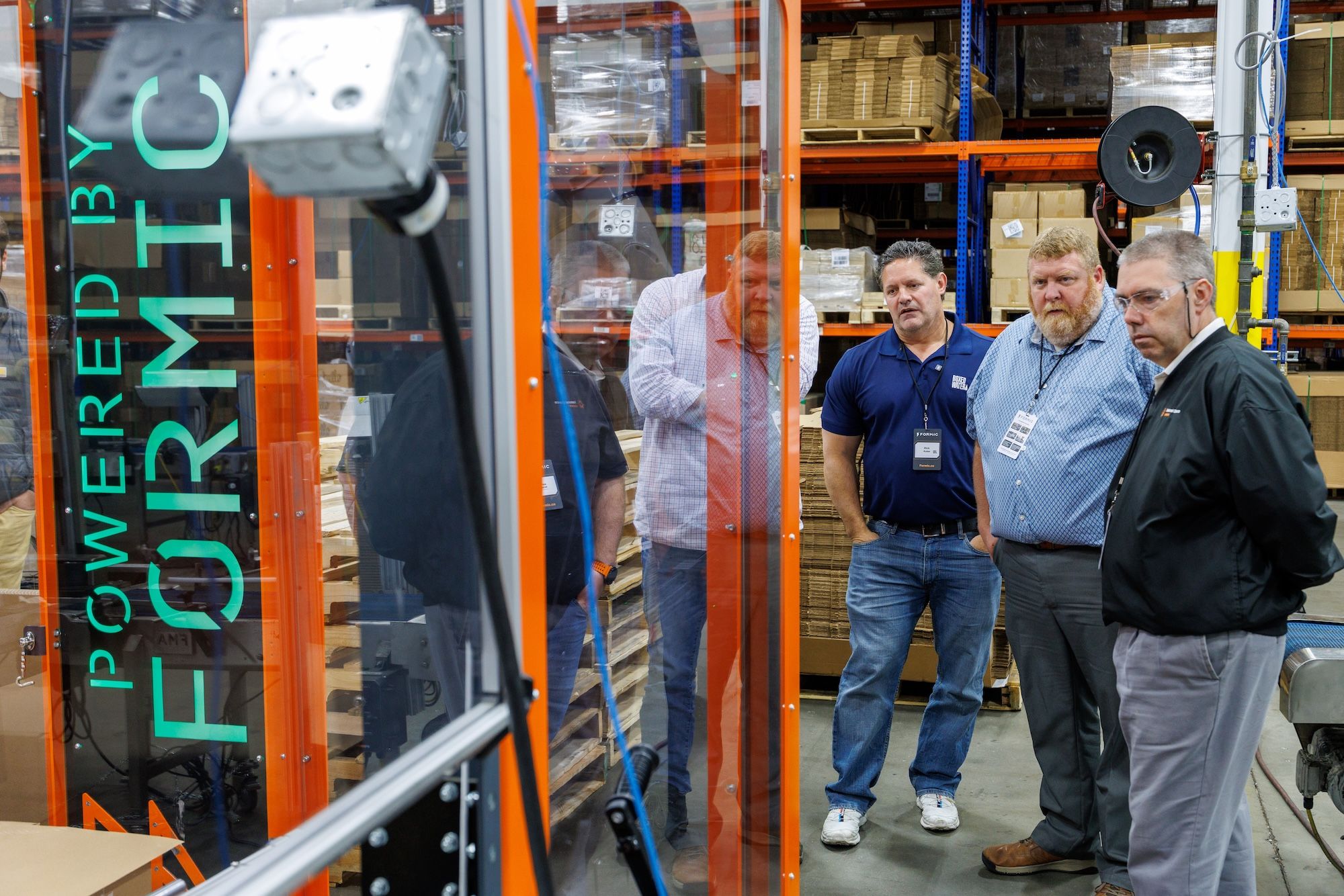
On June 4, Boxed Water Is Better opened its Holland, Michigan, facility to a room full of food, beverage, and CPG manufacturers for the latest Formic Automation Community event. Attendees came from across West Michigan and the Midwest, representing companies ranging from fruit storage and canning operations to chemical manufacturers and co-packers.
They came with the same questions most manufacturers are quietly wrestling with: Is automation actually within reach for a company our size? What does it cost in practice? And what happens when something breaks?
They got answers live on the floor, from operators who've been running Formic systems for months.
The day moved through a presentation on Formic's Full Service Automation model, a tour of Boxed Water's production floor, and a customer panel featuring Rick Kulas (Operations Manager, Boxed Water) and two other Formic customers: a VP of Sales and Operations at a residential coatings manufacturer and a plant manager at an industrial chemicals supplier. Each runs a Formic palletizer in a different kind of facility, with a different product mix and a different set of constraints.
Together, they gave the room an overview of what automation looks like once it's actually running.
Boxed Water's Automation Journey: From Three-Shift Grind to "It Just Runs"
Boxed Water has been in its current Holland facility since July 2023. When Rick joined the company in 2022, the operation was running three shifts, seven days a week, with heavy manual palletizing across multiple lines. A half-liter case of their product weighs about 28 pounds. At peak, lines run two to five cases per minute.
"People get tired after eight hours," Rick said. "Ten hours is even worse. And even though we rotate through the positions, nobody wants to do it. It's heavy, and then people quit, and then you don't have anybody there for production."
That was the breaking point. Boxed Water now runs three Formic systems: a cobot that moves across multiple lines, a compact industrial robot anchored to their highest-volume line, and a third system at their Salt Lake City facility. Together, they've hit 98% uptime. Rick no longer brings in seasonal temp labor for palletizing. He counts each robot as a headcount in his staffing plan.
What surprised him most wasn't the labor savings. It was the consistency.
"The cobot puts the case exactly where it needs to be. It's not leaning. We don't have to worry about how it stretch-wraps or how it goes up in our racks,” he said. Before, a double-wall case that bows slightly would produce unstable pallet stacks. The robot doesn't care about the bow; it just places.
When Boxed Water adds a new SKU or changes a case size, they contact Formic, get a new pallet pattern programmed, run a quick test, and get back to production. Rick described the whole system the way you'd describe a reliable piece of infrastructure: "It's like having an air compressor that just runs, and you don't worry about it."
On the Floor: What Attendees Saw
After the presentation, the group moved to the production floor. For many attendees, it was the first time seeing a Formic palletizer running live product on an active line. They saw both the cobot and the compact industrial in operation, watched how operators interacted with the systems, and asked Rick questions directly.
A few things visibly landed: how little operator time the robots actually require, how quickly the cobot can be repositioned, and how the system handles minor variation in case dimensions without manual adjustment.
The Panel: What It Actually Takes
Back in the meeting room, the panel moved through the questions that manufacturers in the room were most interested in.
What was your operation like before Formic, and what pushed you over the edge?
One panelist described a fully manual process from box erection through palletizing. A single pallet of finished product took one person two to three hours to build, with each unit weighing about 30 pounds. As distribution volume grew, they were throwing four or five temporary workers at the problem and still barely keeping pace.
"We got to a point where we were introduced to Formic, and we asked, 'Can you just come look at our whole process?'" Working with Formic's sales team, they identified end-of-line palletizing as the highest-impact, most automatable step. Formic also helped integrate an erector and sealer upstream. That three-hour pallet build is now a 20-minute process.
The other panelist's answer was simpler: ergonomics. "It's a very elegant solution and it works," he said.
What held you back from doing it sooner?
For one panelist, it was the assumption that automation was only for large companies.
For Rick, it was capital. "We're a small company. The capital outlay was a big thing for us. Explaining it as an hourly rate, or how many hours we run versus financing 130 grand for a robot and figuring out how long it takes to pay that back, when I don't have technical support in house, was the issue," he said. The move to a flat monthly model is what made the math simple enough to say yes.
The third panelist pointed to a tradeshow as a turning point. Seeing the technology live and realizing the service model meant they wouldn't be on their own if something went wrong was enough.
How long until you saw a return?
"Two weeks," said one panelist. Rick called his ROI instantaneous: the first pallet the cobot built was already better than anything being built by hand.
The third panelist said the same, as freed-up labor moved to higher-value tasks immediately.
What surprised you?
Rick's biggest surprise was how smoothly it went compared to every other automation project he'd worked on. "You get promised the world, and you get half a cup full of nothing," he said. "This wasn't the case."
For another panelist, it was durability. Their team has put the robot through some rough moments: "It just keeps on going."
One panelist's team named their robot. They have also asked, seriously, whether it can be programmed to give a high five. (It cannot. Yet.)
Rick's two cobots are named after employees who left the company. "To remember them by," he explained.
What Manufacturers Took Away
The room included plant managers, operations leads, and maintenance coordinators from companies across West Michigan: canning operations, a fresh apple packing and sales company, a chemical manufacturer, a home goods co-packer, and more. Many were early in thinking about automation. A few had tried to buy equipment outright and run into the familiar problems: stranded assets, knowledge gaps when technical staff left, slow support.
The Formic model addresses all of those directly: no capital required, no in-house robotics expertise needed, maintenance and spare parts included, and contracted uptime, with financial penalties if Formic misses the mark. Contracts start as short as three months.
What the panel added was proof. Three customers, three different products, three different facility configurations, all saying roughly the same thing: it's running, it's reliable, and the only complaints they have are about the things they didn't automate sooner.
For manufacturers still on the fence, the message from this Formic Automation Community event was direct: the barriers that used to make automation inaccessible are gone. The question now isn't whether you can afford it; it's whether you can afford to wait.
Missed the event at Boxed Water? Get started on your own automation journey here.