Meeting Every Customer Need: How MattPak Scaled with Automation
Being a co-manufacturer means being everything for everyone all the time. Your job isn’t just to create a good product with your name attached; you must meet the specific standards of dozens of customers so they can deliver consistent quality to their own customers.
That’s the daily reality at Illinois-based contract manufacturer MattPak. Producing everything from spices to laundry and dishwasher pods for businesses of all sizes means balancing constant demands for speed, flexibility, and consistency. Co-Owner and Operations Manager Matt Kunach recognized that automation could provide a critical advantage, not only ensuring orders were delivered on time and in full, but helping MattPak stay one step ahead in a competitive market.
“We recognized that automation is the future,” he said. “We knew we had to get started somewhere and then expand from there.”
The Flexibility to Grow with Automation
While MattPak knew they needed to automate, Kunach said they were initially hesitant to get started because they didn’t have internal robotics expertise. Plus, for MattPak, customer demands shift constantly, requiring a solution that could adapt as quickly as the business.
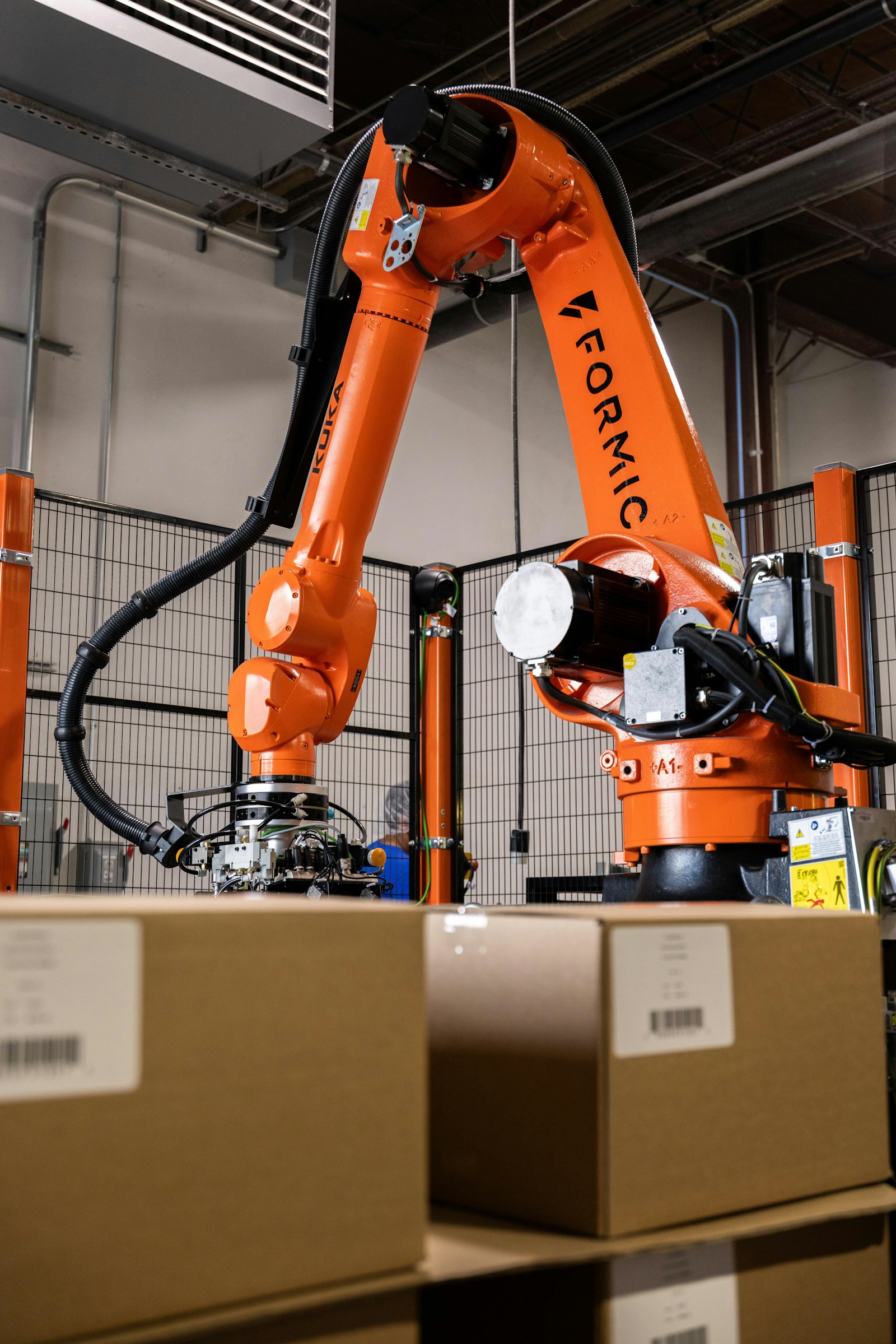
The first opportunity? The end-of-line palletizing process: a repetitive, high-risk job with hundreds of SKUs and complex pallet patterns.
“We looked at palletizing and thought, ‘That’s not a fun job, and it’s a high risk of injury,’” Kunach said. “I’d rather move that person palletizing to a different area that requires more operational decision-making.”
Flexibility was a non-negotiable. MattPak needed a partner who could deliver not only equipment but a solution that evolved with their business. This led them to Full Service Automation, Formic’s Robots-as-a-Service model, which includes 24/7 support, performance-based contracts, and equipment that could swap out as production needs changed: perfect for a growing co-manufacturer.
They partnered with Formic to deploy three palletizing systems and are currently working on adding automated case packing to one of their production lines.
“The big thing for us was wanting to try automation without making a huge upfront investment,” Kunach said. “We didn’t want to buy a palletizer and then realize it wasn’t going to run as promised, or be left to figure it out on our own. We were looking for a partner who would stand behind the system and support us. With Formic, it’s on their team to make it work, and they have.”
Smooth Deployment, Minimal Downtime
Most manufacturers can’t afford to get automation wrong, but they also can’t afford the downtime that can come with a slow deployment process. Kunach said when he first started looking into his automation options, it was hard to visualize how the system would fit in their facility and understand how long it would take to actually see a return on the investment.
Kunach said Formic’s approach immediately stood out: using augmented reality to 3D map the facility, engineers could visualize how the system would fit and optimize it before installation. “Nobody else we talked to had that tool,” Kunach said. “[Formic] came in and just asked for the feed rate and package weight and made it work from there. I didn’t have to do much else.”
Now, MattPak has eliminated downtime from manual recipe changeovers, achieving early wins and streamlining the entire end-of-line process.
“The efficiency of the automated palletizer has been impressive. Some SKUs move through the line quickly, and the palletizer keeps up, building pallets that are ready for the forklift driver to stretchwrap,” he said. “Job changeovers are now faster and simpler.”
Understanding Total Cost of Ownership and ROI
Automation is an investment, but many manufacturers focus solely on the ROI without considering the Total Cost of Ownership (TCO).
“Most palletizers we looked at for our facility ran over $150,000, and the ROI isn’t immediate,” Kunach explained. “With Formic, I don’t have to spend capital upfront. I pay monthly and continually improve operational efficiency. It frees up capital we can use to make improvements elsewhere.”
By shifting to a Full Service Automation model, MattPak can measure labor savings, efficiency gains, and cost reductions directly. Each automated system reduces the hours employees spend on repetitive tasks, allowing them to focus on higher-value work, while the company scales operations without committing to massive upfront capital.
Early Wins and Daily Benefits
Palletizing was just the start. With the system in place, MattPak has identified both early wins (like faster job changeovers and reduced manual handling) and ongoing improvements, such as maintaining high efficiency across hundreds of SKUs with minimal supervision.
“It’s not about cutting labor, we’re focused on growing the company and helping employees work safer and more efficiently,” Kunach said.
Expanding Automation Across the Line
The success of automating palletizing led Kunach to consider other automation opportunities, including case packing, pouch filling, and label application. Each addition builds toward a fully automated production line capable of supporting the company’s growth ambitions.
In the next few years, MattPak plans to expand from its current 55,000-square-foot facility into a state-of-the-art operation spanning more than 100,000 square feet. The new facility is designed to support increased capacity, additional production lines, a broader SKU mix, and expansion into new product segments.
“Getting started with automation opened our eyes. We’re now looking at every step in the production line for opportunities to improve efficiency, safety, and flexibility,” Kunach said.
For MattPak, automation isn’t just a tool; it’s a strategic advantage. By pairing flexible technology with knowledgeable partners, the company is transforming operations, supporting employees, and preparing to meet the needs of current and future customers.
Download Automate NOW Industrial Palletizer Data Sheet